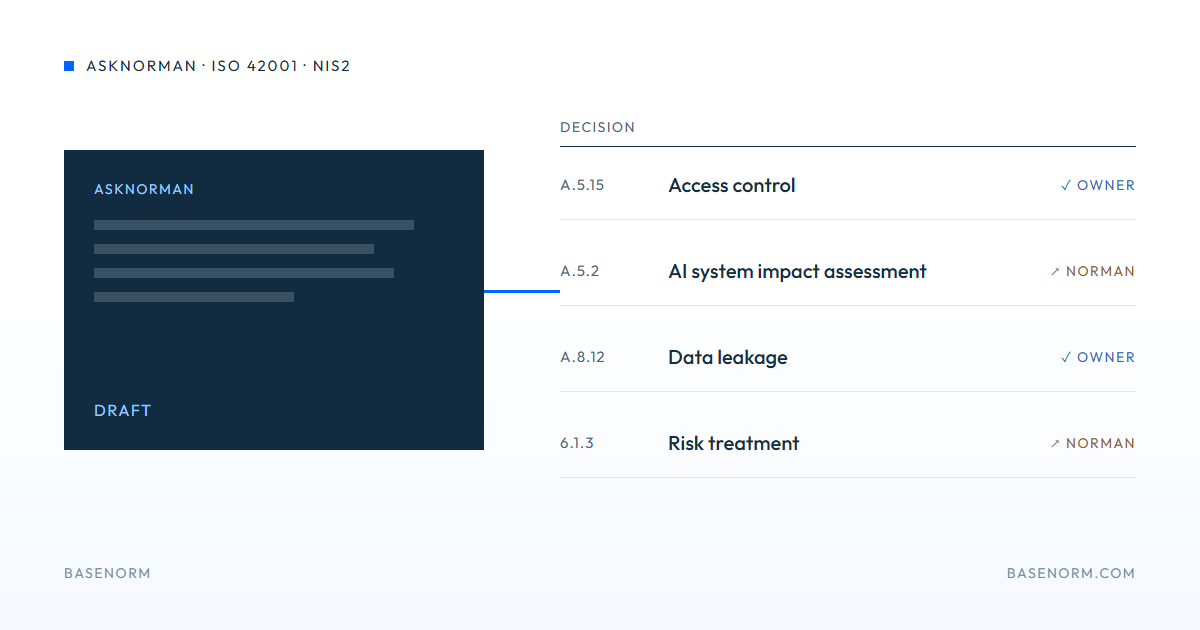
A management system is a record of decisions
ISO 27001 and ISO 42001 do not ask whether a configuration is correct. They ask whether an organisation knows its risks, has decided how to treat them, can show who decided and on what basis, and improves when something goes wrong. Clause 5 of both standards puts that responsibility with top management. NIS2 goes further: under Article 20, the management bodies of essential and important entities approve the cybersecurity risk management measures, oversee their implementation and can be held liable.
An auditor therefore looks for judgement. Who accepted this risk? Why is this Annex A control not applicable? Who decided that this incident was not significant? A status that a tool set on its own is not an answer to any of those questions.
The irony of an autonomous compliance agent
There is a second problem. An AI system that independently assesses controls and changes your compliance status is itself an AI system you have to govern. Under ISO 42001 you would need to inventory it, assess its impact, define human oversight and monitor its performance. The tool that was supposed to remove work adds a new item to your AI management system, and a new question for your auditor: how do you know the agent was right?
Where AI genuinely helps
None of this means AI has no place in compliance work. Much of that work is reading, writing and searching, and that is exactly what language models are good at. They can explain in plain language what a requirement in NIS2 or ISO 42001 asks. They can draft a procedure that your team then adapts. They can search hundreds of controls for the ones without an owner, or the evidence that is out of date. They can prepare an answer to a customer questionnaire from the controls you already have.
In each of these cases the output is a proposal. A person reviews it, changes it and takes responsibility for it. That is not a limitation of the technology; it is the design that keeps your management system defensible.
What to ask before you let AI near your management system
Ask which models are used and where they process your data. Ask whether your data is used to train them. Ask whether the AI can see more than the user who asks the question, because an assistant that bypasses your access rights undoes your access control. Ask whether you can connect your own assistant or use your own API key. And ask whether it remains visible afterwards which text was generated and who approved it.
How AskNorman works
AskNorman is the assistant in Basenorm. It explains requirements, drafts documents and searches your controls, risks and evidence, in Basenorm or through MCP from a supported AI assistant such as ChatGPT or Claude, within the permissions of the user. You can use Basenorm-managed models or bring your own API key. AskNorman assists; your compliance lead or CISO reviews and decides.