Why the delay is not a reason to wait
The Digital Omnibus on AI, Regulation (EU) 2026/1744, entered into force on 27 July 2026. It moves the obligations for stand-alone high-risk AI systems listed in Annex III of the AI Act to 2 December 2027, and those for AI embedded in products under Annex I to 2 August 2028. It does not move what already applies: the prohibited practices and the AI literacy duty since February 2025, the rules for general-purpose AI models since August 2025, and most transparency obligations since August 2026.
Customers are not waiting for the regulator either. Questions about AI now turn up in supplier questionnaires and tenders, and they are usually phrased the way ISO 42001 thinks: which AI systems do you use, who owns them, and how did you assess their impact? An organisation that can answer with evidence has an advantage long before December 2027.
The half you already have
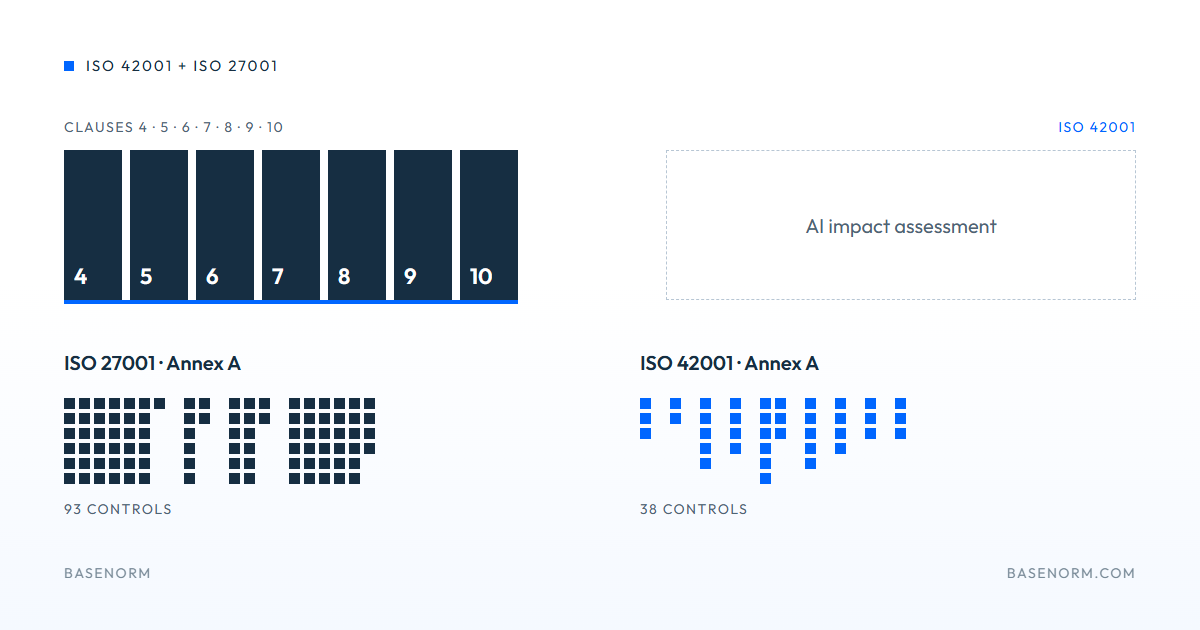
ISO 42001 and ISO 27001 share the same harmonised structure. Clauses 4 to 10 ask for the same management system: context and scope, leadership and policy, planning based on risk, support through competence and documented information, operation, evaluation through internal audit and management review, and improvement through corrective action. If your ISMS works, those processes exist. They need to be extended to AI, not rebuilt.
In practice your document control, internal audit programme, management review and corrective action process can carry the AI management system as well. Your risk methodology can be reused once you add AI-specific sources of risk. And several ISO 27001 controls, such as supplier management, access control and logging, also protect AI systems.
The half that is genuinely new
Three things have no real counterpart in an ISMS. The first is the inventory of AI systems: which systems you develop, provide or use, for what purpose and in which role. Many organisations find at this step that AI is used in more places than anyone had registered, from coding assistants to features quietly switched on in existing SaaS tools.
The second is the AI system impact assessment. An ISO 27001 risk assessment looks at risks to the organisation and its information. ISO 42001 also asks you to assess what an AI system can do to individuals, groups and society: discrimination, safety, loss of privacy, decisions people cannot challenge. That needs people who understand the use case, not only security specialists.
The third is Annex A of ISO 42001 itself: 38 controls under nine objectives, covering AI policy, internal organisation, resources, impact assessment, the AI system life cycle, data for AI, information for interested parties, the use of AI systems and third-party relationships. Data quality, human oversight and responsible use are new territory for most security teams.
A workable order
Start with the inventory, because everything else depends on it. Then set the scope of the AI management system: all AI, or the systems that matter most to customers and to risk. Extend your risk methodology and run the first impact assessments on the systems in scope. Only then go through Annex A and draw up the statement of applicability, with your choices and the reasons behind them. Your existing internal audit and management review can include the AI management system in their next cycle.
Settle ownership early. ISO 42001 requires top management to set the AI policy and assign responsibilities. In practice every AI system needs an owner in the business, while the CISO or security officer keeps the management system together and the privacy officer covers personal data.
How Basenorm supports this
Basenorm runs ISO 42001 and ISO 27001 on one Unified Control Library. Shared controls and their evidence are maintained once and linked to both standards, AI-specific controls are added where they are needed, and each control shows which standard it counts for and which it does not. The ISO 42001 page shows how that works.